Our March/April Issue Is Out!
- March 22
- D&S BLOG
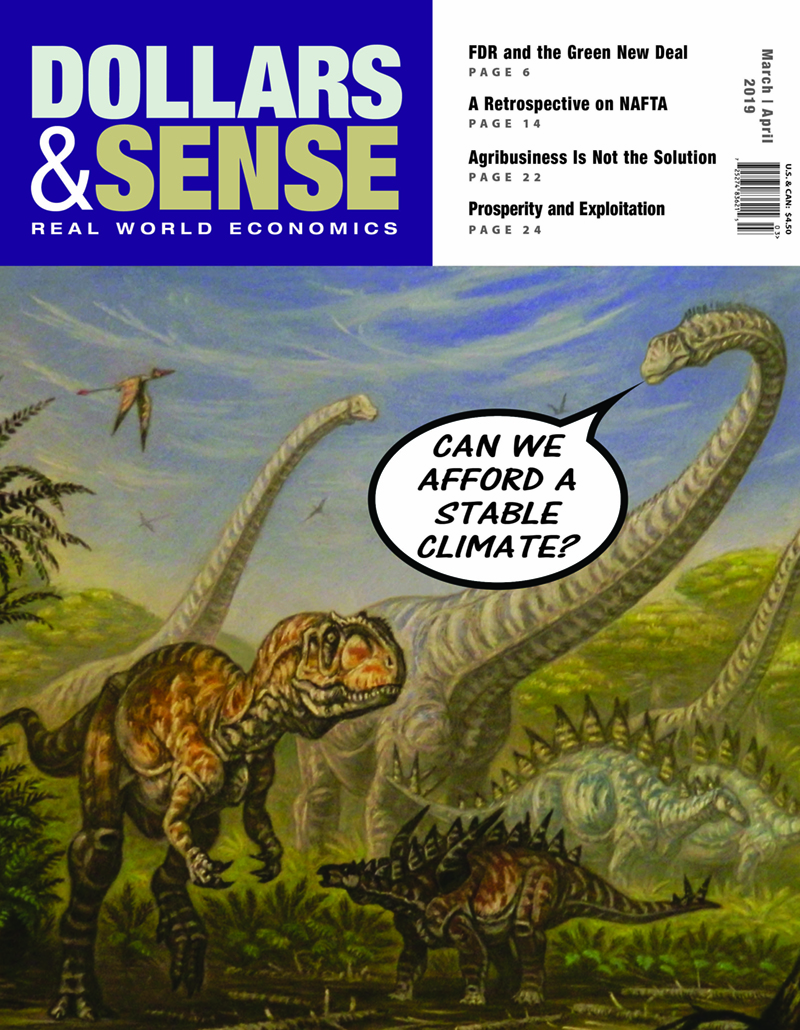 Our March/April issue is out–sent to e-subscribers last week and en route to print subscribers now. We have posted the issue’s cover story, Can We Afford a Stable Climate?, by Frank Ackerman. (Thanks to D&S collective member Jeanne Winner for the cover concept, which perfectly frames the humor in Frank’s title.)
Here is the issue’s editors’ note, including a welcome to our new co-editor, Elizabeth T. Henderson:
Economic Extinction
In early February, The Economist published an article, “A Bold New Plan to Tackle Climate Change Ignores Economic Orthodoxy,” lamenting the fact that the Green New Deal “largely dispenses with cost-benefit analysis.” This issue’s cover story by Frank Ackerman (one of the founders of Dollars & Sense) spells out just why ignoring economic orthodoxy, and cost-benefit analysis in particular, is exactly the right approach for climate policy. When we’re faced with uncertain but extreme risks, as we are with climate change, “policy should be based on the credible worst-case outcome, not the expected or most likely value.” Orthodox economists peddling cost-benefit analysis are like the dinosaurs on this issue’s cover—they should go extinct, as the dinosaurs did as a result of a changing climate. And the rest of us might well go extinct if we let economic orthodoxy determine climate policy.
In our ongoing series on a federal job guarantee, Gertrude Schaffner Goldberg pays tribute to FDR’s Economic Bill of Rights, which turns 75 this year. Goldberg shows how the Green New Deal and related policy proposals could finally realize FDR’s vision and address the climate crisis and economic inequality at the same time. Ackerman also addresses the connections between economic inequality and climate justice in a long sidebar in his cover story.
A second theme of this issue is one of our favorite topics, U.S. imperialism. Arthur MacEwan answers a question that Ryan Cooper, an astute journalist who writes for The Week, posed recently on Twitter: U.S. corporations clearly exploit people in developing countries, but does U.S. prosperity depend on such exploitation? Arthur’s answer introduces a class analysis to address how elites—both in the United States and in the developing countries that corporations exploit—benefit most of all from such exploitation. But so do the rest of us: ordinary people in the United States benefit from low-cost consumer goods, cheap gas, and higher wages trickling down from bosses’ superprofits. Higher living standards have long bought off a “labor aristocracy” that might otherwise have shown solidarity with exploited workers abroad. In the end, there’s no doubt that the exploitation of developing countries is one of the pillars of U.S. prosperity.
U.S. agribusiness is one example of corporate exploitation of the developing world, as the eminent Malaysian economist Jomo shows in his review of the new book by former D&S co-editor, Timothy A. Wise, Eating Tomorrow. Agribusiness corporations influence government policies to favor large farms and industrialized agriculture, with disastrous results for small family farmers and the environment.
And the history of U.S. relations with Mexico provides a perfect case study of U.S. corporate exploitation of the developing world, as James M. Cypher and Mateo Crossa show in their retrospective on NAFTA. The agreement was more about investment than trade, and most of all about corporate access to low-cost labor and resources. If anyone needed more reasons to be skeptical about the Trump administration’s recent saber-rattling at Venezuela—endorsed by too many Democrats—the authors’ long sidebar on how NAFTA fits into the history of U.S. designs on Mexican oil provides plenty. The long history of U.S. interventionism for oil is where the climate crisis and imperialism meet, with oil companies being the central villains. Let’s hope we can make them extinct, too.
Last but not least, we continue our 45th-anniversary celebrations with another excerpt from our archives: from the year that NAFTA was initialized—1992—an article by former D&S staff editor Patricia Horn on the economics of violence against women.***
We at Dollars & Sense are pleased to welcome Elizabeth T. Henderson to our staff as co-editor! Liz previously worked for several years as an editor at the Indypendent in New York City. Her reporting has appeared in Dissent, The Nation, Waging Nonviolence, and the Indypendent. Liz brings extensive editorial, reporting, and fundraising experience to D&S, and her amazing organizational skills are already leaving their mark on the D&S office and our production schedule. Welcome, Liz!
